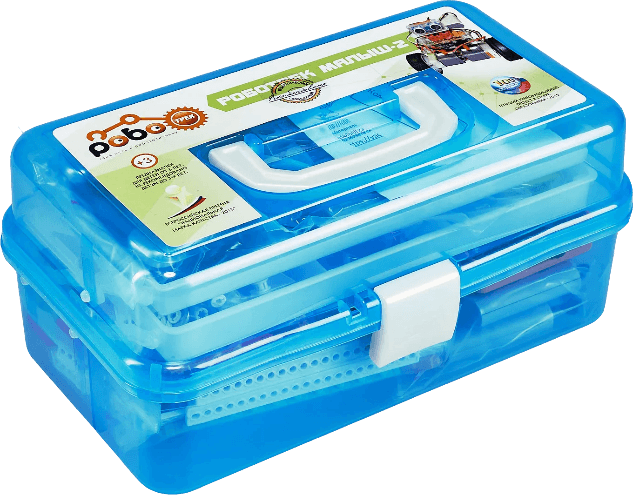
In 2027, the national project “Youth and Children” provides for equipping mathematics classrooms. Robotrack offers an educational solution that meets the requirements for this equipment:
Mathematics, algorithms, and introductory programming kit: Robotrack Malysh 2 Robotics Kit
Russian Ministry of Industry and Trade registry entry No. 10587207
Complies with Clause 2.1.31 of Order No. 838 of the Russian Ministry of Education dated 28 November 2024
Age: from Grade 1
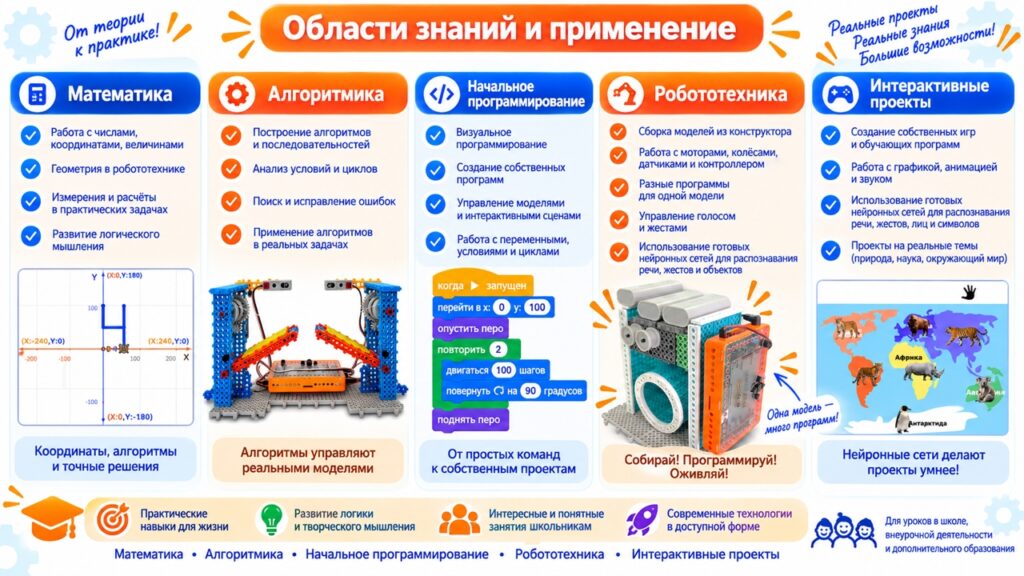
The kit is designed for practical activities in school mathematics and supports the study of robotics, algorithms, and introductory programming. Children build robot models, explore algorithms for arithmetic operations, study geometric shapes and their properties, create programs, control robots, work with conditions and variables, measure quantities, use coordinates and numerical data, and specify sequences of actions.
The teaching materials cover three related areas:
- 20 robotics and introductory programming lessons, each lasting two academic hours.
- 15 lessons on creating algorithms in a visual environment, each lasting two academic hours.
- 36 mathematics and algorithms lessons, each lasting one academic hour (in development).
In robotics and introductory programming workshops, students build working models and program them to move, operate motors, process button and sensor signals, and perform actions according to specified conditions. In sprite workshops, children learn visual programming by creating interactive projects and games.
Mathematics and algorithms activities are primarily intended for extracurricular use as a supplement to lessons. They do not replace a traditional lesson; they add a practical component and help students reinforce and apply mathematical concepts while constructing and modeling robots.
Activities can be used to study key topics in elementary school mathematics, including “Numbers and quantities,” “Arithmetic operations,” and “Spatial relationships and geometric shapes.” The material follows a progression from simple to more advanced concepts.
Mathematics, algorithms, and introductory programming at school
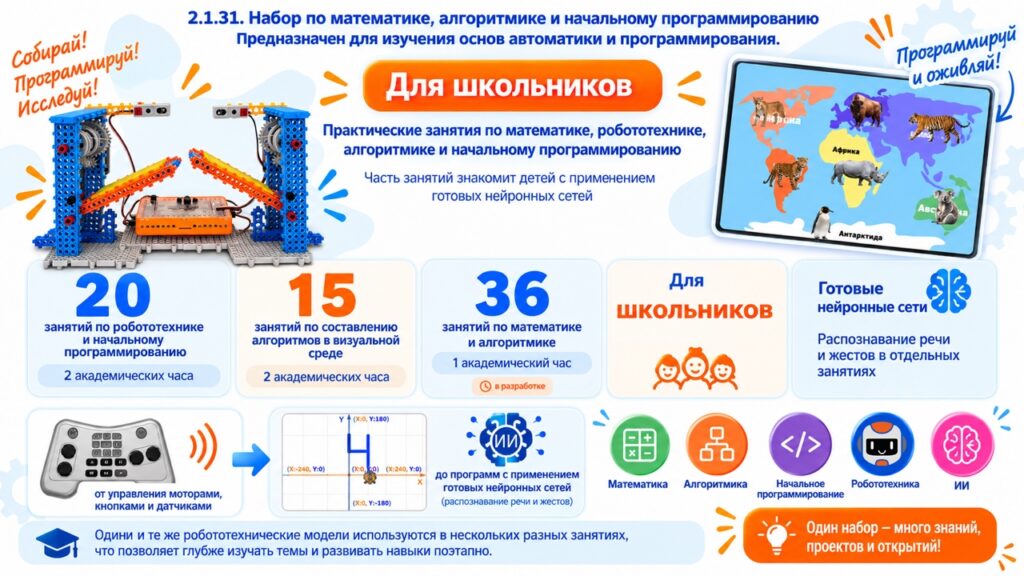
Mathematics
The kit can be used for practical reinforcement of mathematical concepts and operations taught at school. Students practice counting, compare numbers and groups of objects, perform arithmetic operations, explore spatial relationships and geometric shapes, and work with length, patterns, simple tables, and sequences of actions.
Robot models provide a visual, game-based tool for learning. For example, children can count objects with a train, practice geometric shapes while controlling a car, solve tasks with a conveyor, compare robot football results, or complete a mathematical mission with a robot.
Mathematics topics students can practice with the kit
- Cardinal and ordinal counting.
- Comparing numbers and groups of objects.
- Addition and subtraction.
- Number sequences.
- Patterns.
- Spatial relationships and directions of movement.
- Coordinates.
- Geometric shapes.
- Length and measurement.
- Simple tables and data representation.
- Sequences of actions.
- Solving practical and game-based math problems.
Algorithms
Through these activities, children learn to break a problem into steps, put the steps in the right order, follow an example, identify repeated actions, set conditions and check whether they are met, follow an algorithm precisely, analyze errors, and evaluate results. Algorithmic thinking develops both when students work with physical robots and when they program virtual characters. Children see a direct connection:
command → action → result → error analysis → correction → correct result
Introductory programming
Students create programs from blocks in a visual programming environment. They gradually use events, command sequences, “if–then” conditions, loops, variables, comparisons, coordinates, messages between objects, and other basic programming constructs.
Robotics
In robotics lessons, students assemble mechanical structures, connect a controller, motors, and sensors, and program models. They create their first robotics projects, such as a car, automatic gates, an elevator, a bridge, a crane, a mixer, a windmill, and a washing machine.
Programming interactive projects
Another area includes lessons on designing and programming sprites (virtual characters). Students create games and interactive projects, control object movement, use a coordinate plane, conditions, variables, events, and more.
What children will learn
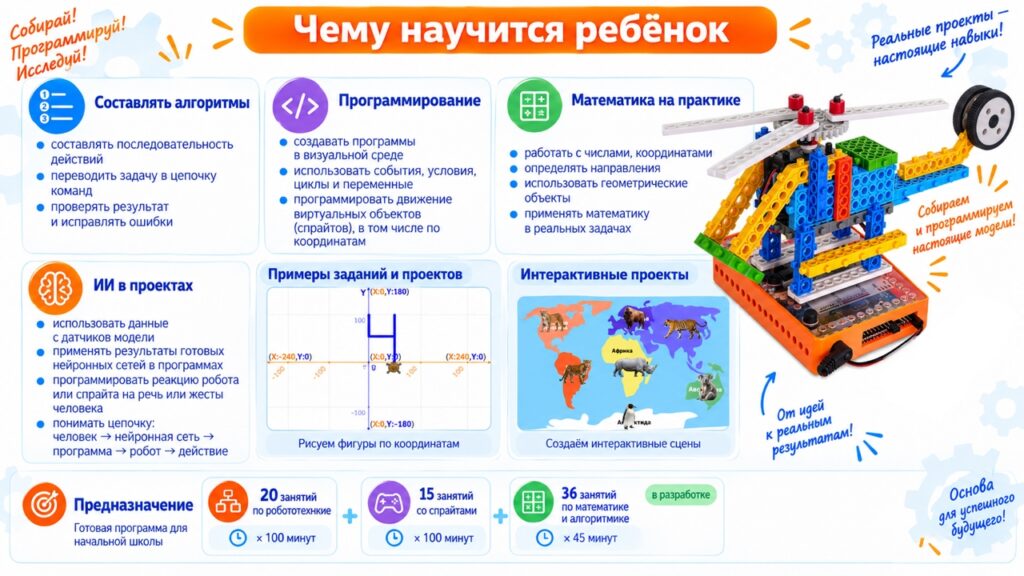
As they work with the kit, students gradually learn to:
- Understand and create sequences of actions and algorithms.
- Turn a task into a sequence of commands.
- Create programs in a visual programming environment.
- Use events, conditions, loops, variables, and numerical values.
- Program the movement and behavior of virtual objects.
- Build and program robot models.
- Control motors and use sensor data.
- Find errors in an algorithm or program and correct them.
- Apply mathematical knowledge in practical, game-based situations.
- Work with numbers, comparisons, coordinates, directions, geometric objects, and patterns.
The learning pathway progresses from following a simple instruction and controlling a ready-made model to independently creating algorithms, solving practical problems, and writing programs.
Intended use
The kit is designed for lessons, extracurricular activities, and supplementary education.
It supports several related areas of learning:
| 20 robotics lessons × 100 minutes | Building, connecting, and programming physical models. |
|---|---|
| 14 sprite lessons × 100 minutes | Learning algorithms and visual programming through interactive projects. |
| 36 mathematics lessons × 45 minutes (in development) | Practical, game-based reinforcement of selected elementary mathematics topics using the kit's models. |
The teaching pathway provides for at least 50 lessons, introducing students progressively to mathematics, algorithms, introductory programming, and robotics.
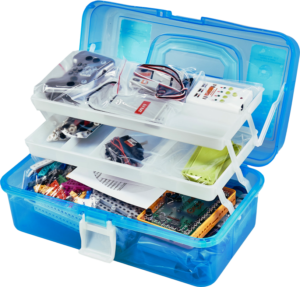
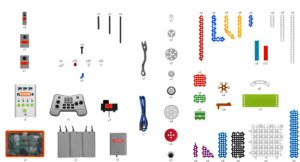
The kit includes:
At least 302 components:
- Plastic beams (5 types) and blocks (10 types) in different shapes for building structures.
- Wheels (4 types), gears (3 types), and a gear wheel.
- Plastic axles (4 types), plastic bushings (2 types), plastic and rubber couplings, flat plastic frames (3 types), platforms, rubber plates, eyes, angle brackets, levers, and arcs.
- 2 mainboards (controllers): an entry-level programmable controller and a multifunctional Trekduino controller.
- 2 DC motors.
- A set of sensors (3 types): 2 IR sensors, 1 remote-control sensor, and 1 sound sensor.
- 1 USB cable for the TREKDUINO controller.
- 2 battery holders (6 V and 9 V AA battery cases).
- A wrench.
- 1 remote control.
- Software and installation instructions.
Products for mathematics lessons