Number of participants
In its three years, the DETalka festival has become a major event in educational robotics in Russia. This year, more than 400 children from 40 cities in Russia and Kazakhstan attended—three times as many as the previous year. In 2016, 138 children from 20 cities took part in the in-person stage; in 2015, the competition was held online only.
More than robotics
Starting this year, DETalka is a festival of educational robotics and neurotechnology. Nadezhda Babenkova, the contest founder and co-founder of Brain Development, explained that this reflects the roadmap of the National Technology Initiative for training specialists for the NeuroNet market.
Participants’ ages
Until 2017, DETalka focused on preschoolers and children up to age 11. This year, many schoolchildren also took part: 27% of participants were aged 11–16, 58% were 7–10, and 15% were under 7.
The participation of older students was supported by the launch in 2016 of Robotrek kits based on the multifunctional Trekduino controller, additional sensors, and expanded software capabilities. These developments made it possible to solve more complex problems and create more substantial, functional, and practical projects with teenagers and older students.
Participants’ geography
Children at DETalka 2017 came from nearly every region of Russia, from Saint Petersburg to Kamchatka, as well as from Kazakhstan.
Support from leading ministries and organizations
The festival was supported by the Ministry of Industry and Trade, the Ministry of Education and Science of the Russian Federation, the NeuroNet industry union, the Educational Technology Navigator, the Agency for Innovative Development, Moscow City University, and others.
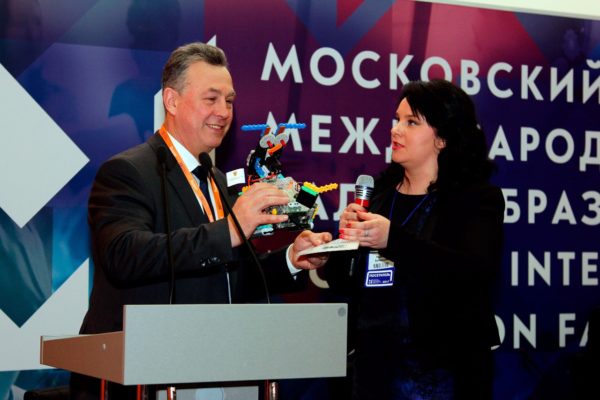
At the opening ceremony, prominent figures in education addressed the participants, including Veniamin Kaganov, Deputy Minister of Education and Science of the Russian Federation.
Veniamin Kaganov and Nadezhda Babenkova at MMSO 2017
For the first time, the event was held at the Moscow International Salon of Education (MMSO), one of Russia’s largest education events. The festival became part of a large exhibition of modern educational technologies.
International cooperation
DETalka is part of international cooperation with the International Youth Robotics Association (IYRA) to develop educational robotics. It served as a qualifying round for children aged 5–16 for the International Youth Robotics Competition (IYRC). The IYRC 2017 final will take place in Malaysia from August 2 to 5. Its core platform is the Robotrek-Huna-MRT kit line.
Academic cooperation
Mikhail Kurnosenko, senior lecturer at the Institute of Mathematics, Informatics, and Natural Sciences at Moscow City University and a judge in DETalka’s creative category, explained that festival organizer Brain Development collaborates with the university and participates in Russia’s first Pedagogical STEM Park. Master’s students in Mechatronics, Robotics, and Electronics in Education also served as judges at DETalka.
Conferences at DETalka
This year, the festival held two conferences for team leaders, coaches, and parents on educational robotics and neurotechnology.
New competition categories
New events were introduced at this year’s DETalka robotics festival:
- Computer Vision Labyrinth. This event was introduced with the new VidereTrek and NeuroTrek kits for building computer vision robots and projects with brain-computer interfaces.
- Neuro-racing. Children controlled a mobile robot platform they had assembled using a brain-computer interface. They wore a headset that measured their levels of meditation and concentration. The data was sent to a computer for analysis. When the meditation level reached 70% or higher, a signal was sent to the Trekduino board on the robot, and the programmed motors set it in motion. The participant’s task was to relax as quickly as possible to start the robot.
Dmitry Ustinsky, a judge in Neuro-racing, said this new DETalka event quickly became popular, with around 100 people registering. Learning to relax is an important skill that helps people overcome difficulties and related stress. Some children even sat in yoga poses to reach the necessary relaxed state.
The winner in the older age group needed just over one second to reach a meditative state and guide the robot through the entire course—a small record.
Computer Vision Labyrinth
Participants assemble a mobile robot platform from a Robotrek kit and a VidereTrek resource kit in advance. The ViTrek controller processes the image from a USB camera. To navigate the maze, the robot recognizes a QR code shown by the operator and uses it to decide whether to turn right, left, or around.
Traditional DETalka events
Traditional events include Mission for Preschoolers, RoboFootball, RoboVolleyball, Line Following, Sumo, and creative projects.
The themes of DETalka 2017 creative projects were kitchen robots and robotic assistants. Participants’ robots poured juice, made omelets, decorated Easter eggs, prepared sushi, chopped salad, and more. Judge Mikhail Kurnosenko noted that some projects were very detailed. One juice-dispensing machine built from a construction kit was almost an industrial prototype.
DETalka’s values and principles
Nadezhda Babenkova, founder of DETalka, says it is first and foremost a festival, not just a competition. There is always a cultural program and time to connect. This year, two excursions were organized: to Red Square and the Kremlin, and a sightseeing tour of Moscow. DETalka is a place to meet and exchange experience. Its main principle is that no one is left unnoticed. Every child received a prize and a certificate of merit, and left the awards ceremony happy and eager to keep learning, improve, and discover new things.
What’s next?
Brain Development has begun developing the Young Neurophysiologist-Engineer educational hardware and software system. It will let children study human neurophysiology, record and interpret biometric data, and control robotic systems. A new competition event may appear at DETalka in 2018.
Results of the DETalka 2017 festival