
Vitrack is a multifunctional microcomputer built around a 64-bit, quad-core ARM Cortex-A53 processor running at 1.2 GHz. It combines a Trackduino controller with a Raspberry Pi 3 microcomputer.
Raspberry Pi 3 specifications
- Broadcom BCM2837 chipset with a 1.2 GHz, 64-bit quad-core ARM Cortex-A53 processor.
- Wi-Fi: 802.11 b/g/n.
- Bluetooth 4.1 (Classic and Low Energy).
- Dual-core VideoCore IV multimedia coprocessor; 1 GB LPDDR2 memory.
- Supports current ARM GNU/Linux distributions and Windows 10 IoT.
- Micro-USB power connector for a 2.5 A power supply.
- One 10/100 Ethernet port.
- One HDMI video/audio connector and one RCA video/audio connector.
- Four USB 2.0 ports.
- 40 GPIO pins.
- DSI display connector.
- MicroSD card slot.
Trackduino controller features
- CPU 2: ATmega2560 (256 KB flash memory).
- Eight powered input ports (GND–Vin–S), all with ADC; ports 1–4 support interrupts; selectable 5 V/3 V supply.
- Eight powered output ports; ports 1–5 provide hardware PWM; selectable 5 V/3 V supply.
- Four DC motor ports driven by two L293 drivers with overcurrent protection.
- RGB LED.
- Two exposed USART ports with power (RX, TX, 5 V, GND).
- Two exposed I2C ports with power (SCL, SDA, 5 V, GND).
- Connects to a computer via USB or Bluetooth.
- Supply voltage: 7–12 V. Two connectors: a jack for the included battery pack and a screw terminal for other power sources.
- Weight: 235 g.
- Dimensions: 125 × 90 × 50 mm.
The controller board is enclosed in a case that blocks access to some ports intended for advanced users, such as the HDMI monitor port, audio jack, DSI display connector, and Micro-USB auxiliary power connector. Remove the case cover to access them.
Power
The board can be powered by USB or an external source. External power connects through the Jack connector or screw terminal (TERM). USB/external switching is automatic; switching between the jack and terminal is manual with jumper XP13.
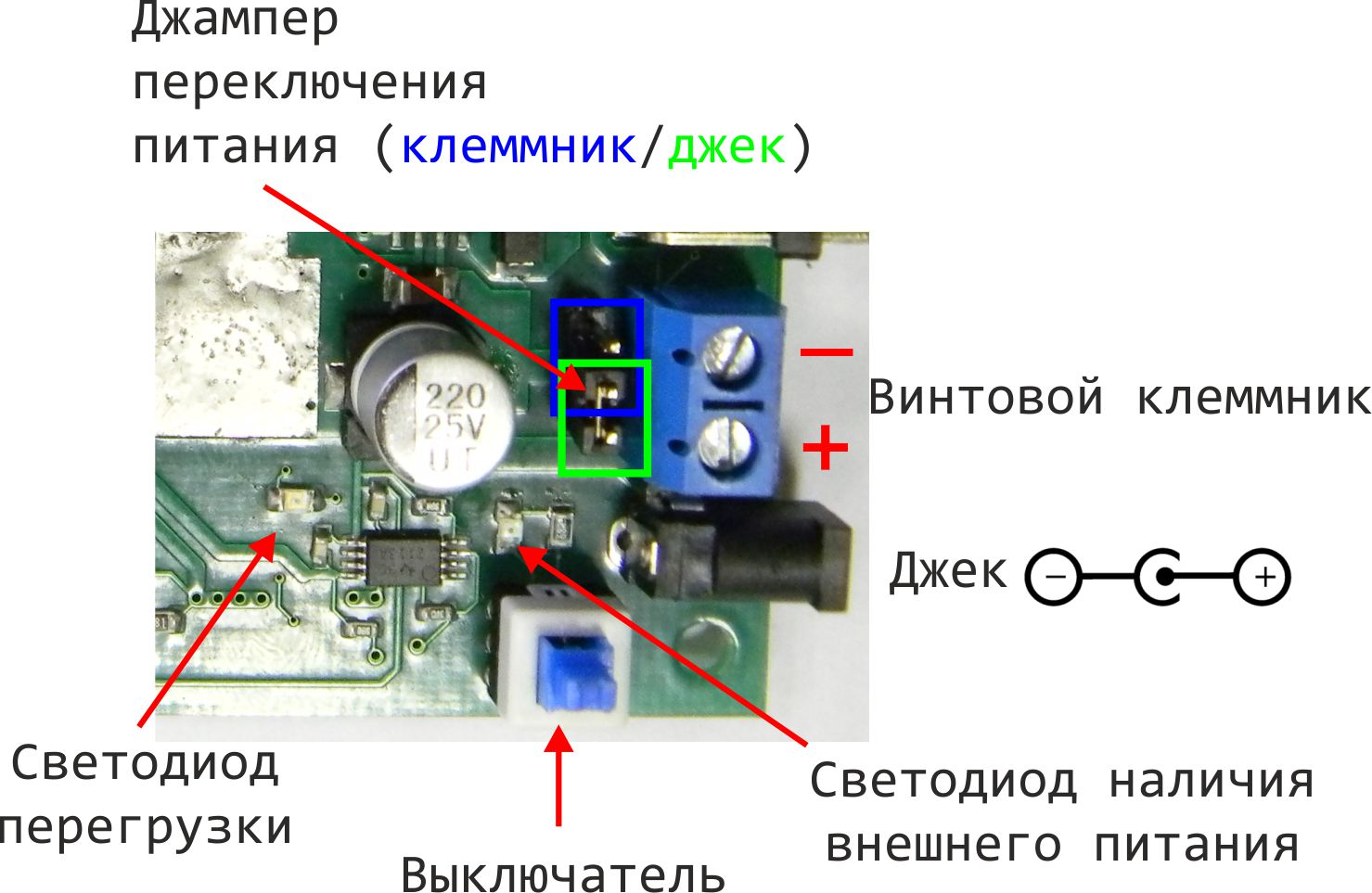
Power requirements: USB: exactly 5 V. External power: 7–12 V. Sources may include a 9 V battery holder with six AA cells, Li-ion batteries with a combined voltage no higher than 12 V, or a 7–12 V DC supply rated for at least 500 mA (1–3 A with several motors and servomotors).
Weak sources, such as alkaline or NiMH batteries and low-power adapters, may experience voltage drops under heavy loads, resetting the controller. Heavy loads include abruptly stopping or stalling motors, reversing motors before they stop, connecting many servomotors, or using servomotors to lift excessive loads.
Motor power comes directly from the external source without voltage reduction. Do not exceed motor voltage limits. Robotrack kit motors are rated for a maximum of 9 V.
USB power is recommended for projects without high-current devices such as motors and servomotors. External power is required for projects using motors or more than two servomotors.
For longer microcomputer operation, you can also connect a 5 V external power source to the Micro-USB port, such as a portable phone or tablet charger.
When connected to an HD video camera, this microcomputer can be used for:
- Face recognition.
- Line following.
- Detecting graphic primitives (circles).
- QR-code recognition.
- Motion detection.
- Frame color analysis.