
Equipment has been developed to prepare learners aged 12 and older for future careers in neurotechnology, neurophysiology, and human psychophysiology, in line with the Digital Economy Program, the “Personnel and Education” project, the national Education project, and NTI roadmaps.
Main kits
Neuroheadset
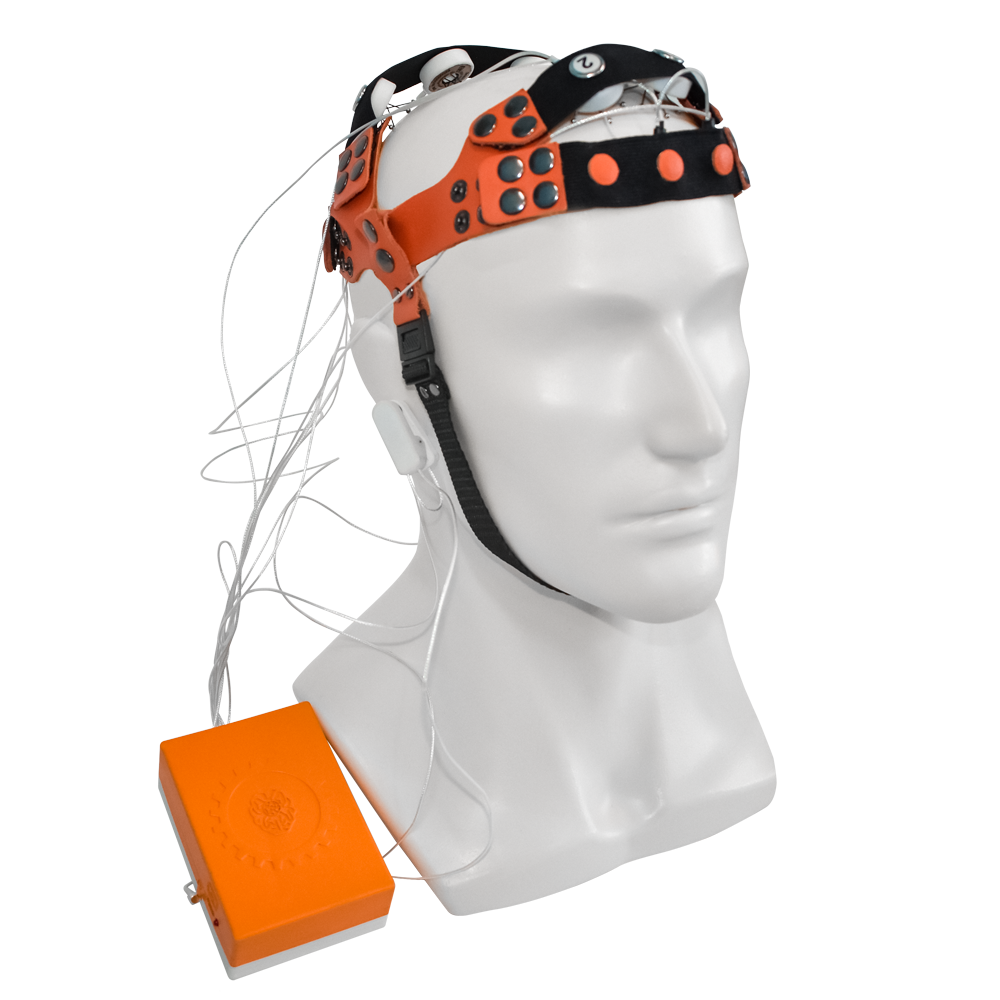
The EEG neuroheadset is designed to conveniently record an electroencephalogram (EEG) from the scalp and transmit it to a computer or equivalent device.
Neuroheadset set contents
- Neuroheadset amplifier unit.
- At least 8 dry electrodes for EEG recording.
- At least 2 reference EEG electrodes.
- One ground electrode.
- 5 V rechargeable battery pack with micro-USB charging.
- Head and shoulder fastening system.
- Micro-USB-to-USB cable for connecting the amplifier unit to a computer.
Neuroheadset amplifier unit
The amplifier unit records the brain’s bioelectrical activity through connected EEG electrodes, processes it, and transmits the scalp EEG or derived signals to a PC or equivalent device.
Specifications
- Dry skin-electrode contact (no gel).
- Skin-electrode contact impedance measurement: 0.02–2.0 MΩ.
- EEG recording channels/electrodes: 8.
- Reference EEG channels: 2.
- Ground electrode channels: 1.
- Common-mode rejection ratio: 90 dB.
- Maximum input EEG amplitude range: ±1.0–300.0 μV peak-to-peak.
- Input-referred amplifier-channel amplitude noise in the minimum band: ±0.3 μV peak-to-peak.
- Continuous EEG recording time: 90 minutes.
- At least 8 electrode-skin contact indicators.
- One power indicator and one PC-connection indicator.
- Neuroheadset weight without power source and EEG electrodes: 600 g.
- Wired charging.
- Wired and wireless (Wi-Fi) connection to external devices.
- Amplifier housed in a plastic enclosure.
EEG recording electrodes
- Electrodes meet GOST ISO/IEC 17025-2009 requirements.
- Record scalp EEG without conductive gel.
- Two electrode designs are provided: for scalp areas with hair and for areas without hair.
- Each EEG electrode supports at least 100 reuse cycles.
Battery
- Input and output voltage: 5 V.
- Capacity: 6,000 mAh.
- Dimensions: 13 × 7 × 1 cm.
- Charge/discharge indicator.
Head and shoulder fastening system
- Head mount secures 8 dry electrodes and labels their positions.
- Shoulder mount secures the battery pack.
- Adjustable for head circumferences from 51 to 60 cm.
- Mount for the neuroheadset amplifier unit.
- Electrode positions are close to the international 10–20 system: Fp1, F3, F4, P3, Pz, P4, O1, Oz, O2, A1, A2.
- Strap secures EEG electrode wires.
Electroheadset
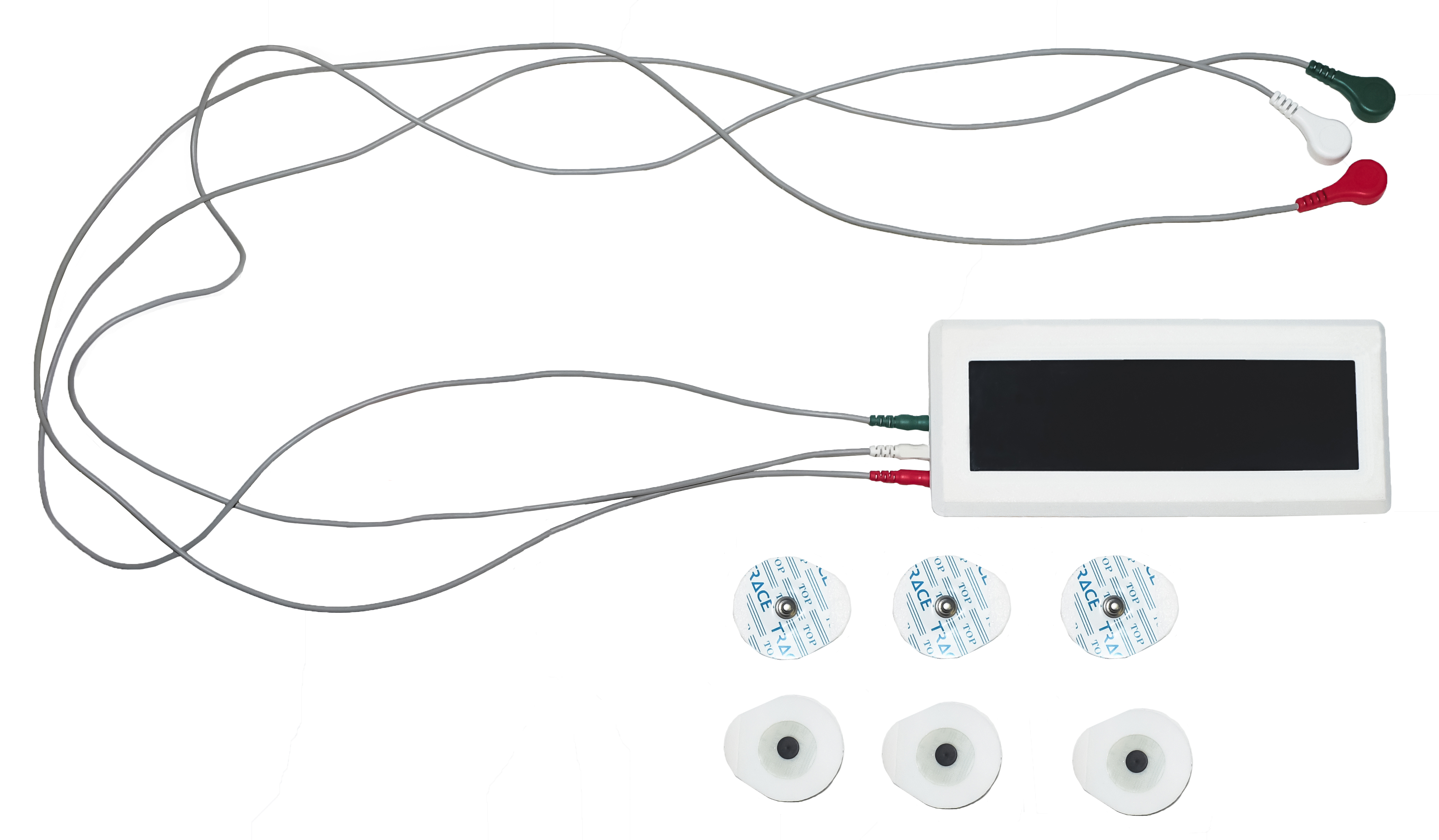
The Electroheadset records, processes, and transmits ECG, EMG, PPG, or derived signals to a PC or equivalent device.
Electroheadset set contents
- Electroheadset electronic unit.
- At least 50 disposable electrodes for ECG and EMG measurements.
- At least three Touch Proof cables for connecting electrodes to the electronic unit.
- At least one mini-USB-to-USB cable for connecting the unit to a computer.
Electroheadset electronic unit (EEU): specifications
- Continuous operation in ECG, EMG, or PPG mode: 90 minutes.
- Weight: 650 g.
- Wired charging.
- Wired and wireless (Wi-Fi) connection to external devices.
- Wired connection for EMG recording electrodes.
- Built-in optical sensor for the PPG block.
- Wired connection for ECG recording electrodes.
- Built-in color touchscreen displays ECG, EMG, and PPG signal values.
- Module housed in a plastic enclosure.
EEU modules
- Electrocardiography block.
- Electromyography block.
- Photoplethysmography block.
EEU electrocardiography block
- Skin-electrode contact; measured contact impedance: 0.02–2.0 MΩ.
- One ECG channel and one RLD channel.
- Maximum input ECG amplitude range: ±0.1–10.0 mV peak-to-peak.
- Input-referred amplifier-channel amplitude noise in the minimum band: ±0.015 mV peak-to-peak.
- Displayed heart-rate range: 40–200 beats/minute.
- Heart-rate measurement accuracy: ±1% of the average.
- ADC effective resolution (noise-free): 18 bits (110 dB).
- ADC sampling rate: 150 Hz.
EEU electromyography block
- Skin-electrode contact; measured contact impedance: 0.02–2.0 MΩ.
- One EMG channel.
- Common-mode rejection ratio: 90 dB.
- Maximum input EMG amplitude range: ±0.1–5.0 mV peak-to-peak.
- ADC effective resolution (noise-free): 16 bits (98 dB).
- ADC sampling rate: 1,500 Hz.
EEU photoplethysmography block
- Optical sensor.
- One PPG channel.
- Displayed heart-rate range: 40–160 beats/minute.
Color touchscreen
- Screen diagonal: 5.2 inches; resolution: 480 × 120 pixels.
- Color interface and capacitive touchscreen.
- Minimum viewing angle: 55°.
- Brightness: 880 cd/m².
- Dimensions: 140.4 × 49.87 mm.
- Operating temperature: −20°C to 70°C.
Course program

Young Neurophysiologist-Engineer course
The course consists of 67 lessons with theory and five types of lab work: neurophysiology; neurophysiology and robotics; interactive neurophysiology; robotics; and polygraph-system laboratory work.
Unit 1. Introduction to neurotechnology
6 hours, 3 lessons. Learners explore high technology, emerging markets and their career prospects, the role of neurotechnology today, and the bioelectrical activity of living organisms: why it occurs and how it is assessed, using a photoplethysmogram as an example.
Unit 2. ECG (electrocardiogram)
22 hours, 11 lessons. Learners study cardiac physiology, heart structure and function, human circulation, cardiac mechanisms and electrophysiological activity, ECG recording and electrode placement, and ECG lead types. They learn to construct the heart’s electrical axis, identify key ECG features, analyze heart rhythm, and interpret an electrocardiogram.
Unit 3. EMG (electromyography)
12 hours, 6 lessons. Learners study muscle types and activity, innervation and muscle function, recording muscle potentials, peripheral nerve conduction, galvanic skin response, and measures of skin electrical activity. They also explore sweating, skin, and human psychoemotional state.
Unit 4. The brain and its functions
12 hours, 6 lessons. Learners study the structure and functions of brain regions and lobes, how neurons work, and their role in the human body.
Unit 5. Electrophysiological methods for studying the brain
8 hours, 4 lessons. Learners explore the history of neurophysiology and psychophysiology and major twentieth-century discoveries, practice using the neuroheadset, study the brain’s electrical activity and EEG, learn electrode-placement systems, and survey methods for studying the brain.
Unit 6. Main EEG rhythms and preparing to record an EEG
8 hours, 4 lessons. Learners study how modern electroencephalographs work, EEG rhythms and components, how to isolate non-cerebral signals, human biorhythms, and the features and conditions for recording the alpha rhythm.
Unit 7. Rhythms
10 hours, 5 lessons. Learners continue studying EEG rhythms and develop an understanding of human states such as wakefulness and rest.
Unit 8. Evoked potentials
12 hours, 6 lessons. Learners study the concept of an evoked potential, pattern types, and the main components of evoked potentials, including auditory P-200, visual P-300, and the mu rhythm. They explore methods for investigating evoked potentials in cognitive tasks.
Unit 9. Brain-computer interface
12 hours, 6 lessons. Learners explore the brain-computer interface, its history and development, wireless data-transfer principles, mathematical economics and optimal strategy selection, and the history of team games. They learn about current directions in brain-computer interface development and the main activities of engineering professions.
Unit 10. Neurotechnology applications and human psychophysiology
16 hours, 8 lessons. Learners study human psychophysiology and functional state, work effectiveness, biofeedback and its practical use, polygraph-mode measurements, and laboratory load tests. They learn about load tests and their use in everyday life, polygraph indicator analysis, biofeedback, and regulation of a person’s functional state.
Unit 11. Device control
10 hours, 5 lessons. Topics include principles of controlling modern devices, virtual and augmented reality, bionics, control in two- and three-dimensional space, and an introduction to neuroprogramming.
Unit 12. Career guidance
4 hours, 2 lessons. Learners explore careers related to neurotechnology and career guidance methods. Self-ranking and assessments are used to identify professionally important qualities with an expert system for comprehensive personality analysis. The source identifies this system as an original development patented by A. M. Bely, Candidate of Medical Sciences, professor at the Military Medical Academy’s Department of Military Psychophysiology and a physician-psychophysiologist.
Resource kits
Neurotrack resource kit (neuroconstruction set)
The kit includes
- One Neuroheadband.
- One micro-USB charging cable.
- Link to software and instructions.
Neuroheadband specifications
- Sampling rate: 512 Hz.
- Frequency range: 3–100 Hz.
- Maximum current consumption: 15 mA at 3.3 V; operating voltage: 2.97–3.63 V.
- UART (COM): 9600 baud.
- Bluetooth version: 2.1; range: up to 10 m.
- Bluetooth power consumption: 80 mA while connected and transmitting.
The kit includes a digital teaching and learning package at no extra charge (provided after a network cooperation agreement is signed), access to Robotrack IDE, online teacher training, and technical support.
Software version 1.1.9 is available to purchasers of the Videretrack and Neurotrack resource kits. It supports wireless data transfer between boards over Bluetooth. The download link is included with the kit.
Learn more about neurotechnology.