Educational laboratories · Middle and high school · Vocational and higher education · Electrical engineering · Ministry of Industry and Trade register
The Robotrack Electrical Engineering educational kit is designed for project work and for teaching children and teenagers the fundamentals of electronics, electrical engineering, microprocessors, and programming electronic devices. Students can build circuits, program smart systems, work with sensors and motors, and develop interactive projects while building engineering skills and learning to use modern technologies.
- Age
12 years and up
Description and specifications
Registry entry of the Ministry of Industry and Trade of the Russian Federation: No. 10706078.
Age: 12 years and up. The 30-lesson Fundamentals of Electronics, Electrical Engineering, Microprocessors, and Electronic Device Programming course (in Russian).
Complies with Order No. 838 of the Russian Ministry of Education dated 28 November 2024 (clauses 2.14.20, 2.20.163, and 2.20.172) (in Russian). More on the Wiki (in Russian).
The Robotrack Electrical Engineering educational kit is designed for building circuits, programming smart systems, including systems for agricultural applications, working with sensors and motors, and developing interactive projects. According to Russian Ministry of Agriculture letter No. КШ-13-27/9712 dated 6 May 2025, it corresponds to item 8, “Educational kit for electronics, electromechanics, and microprocessor technology,” in the “Agroengineering” section of the sample equipment list for agricultural technology classes (details, in Russian). The kit is also recommended as a practical supplement for physics lessons (in Russian).
Product qualities
- safe to use: safe ABS plastic and acrylic, housings for electronic components, additional wire insulation, and no sharp corners;
- wear-resistant;
- repairable;
- versatile;
- high reliability for use by children;
- ergonomic;
- high performance and easy to use.
The educational kit includes a circuit assembly board and additional components. The assembly board simplifies building circuits and allows them to be assembled and tested without soldering. To build a circuit, users insert wire terminals into sockets to connect the contacts. This wiring method is safe, simple, and easy to understand.
The educational kit can be integrated with artificial intelligence neural networks to control robots, using ready-made networks or networks developed in NNTrack.
Components inside the circuit assembly board
- WS2812B-V5 addressable LEDs — 8;
- FYLS-5050RGB RGB LED — 1;
- FYLS-5050UWC white LED — 1;
- FYLS-5050PG3C green LED — 1;
- FYLS-5050UR3C red LED — 1;
- FYLS-5050UY3C yellow LED — 1;
- IT-1102WD buttons — 4;
- JCK1E471M100105 capacitors — 2;
- JCK1E101M063077 capacitors — 2;
- CR-05FL7–220R resistors — 11;
- CR-05FL7–100R resistors — 8;
- CR-05FL7–1K resistors — 2;
- RC0805JR-0710KL resistors — 2;
- R1212N-A10K potentiometers — 2;
- 1.3-inch I2C OLED display — 1;
- DS1023-2X2 (PBD 4) connectors — 87;
- DS-1023 1×3 (PBS-3) connectors — 4;
- DS-1023 1×4 (PBS-4) connector — 1;
- MTS-102-A2 on-on toggle switches — 2;
- MKA-14103MS reed switch — 1;
- TMB12A03 buzzer — 1;
- GL5506 (4–7K) photoresistor — 1;
- SI2300A MOSFET transistor — 1;
- SS8550 PNP transistor — 1;
- KPA-3010P3C infrared phototransistor — 1;
- AA-57×17 battery holders — 8;
- DS-205 power socket — 1;
- SS34 Schottky diodes — 2;
- SPQ105-101M inductor — 1;
- KP-2012SGC KGB/Green LED — 1;
- microphone module — 1.
Additional components
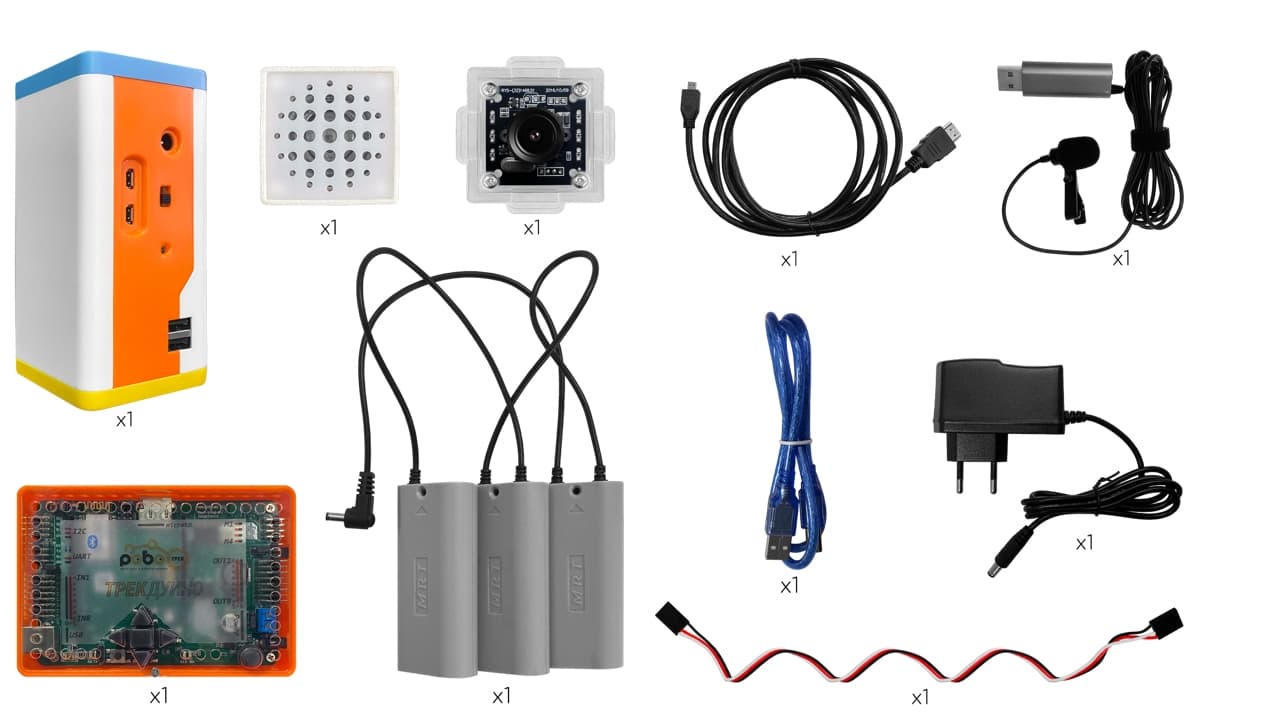
- enclosed Trackduino PRO board — 1;
- ultrasonic distance sensor — 1;
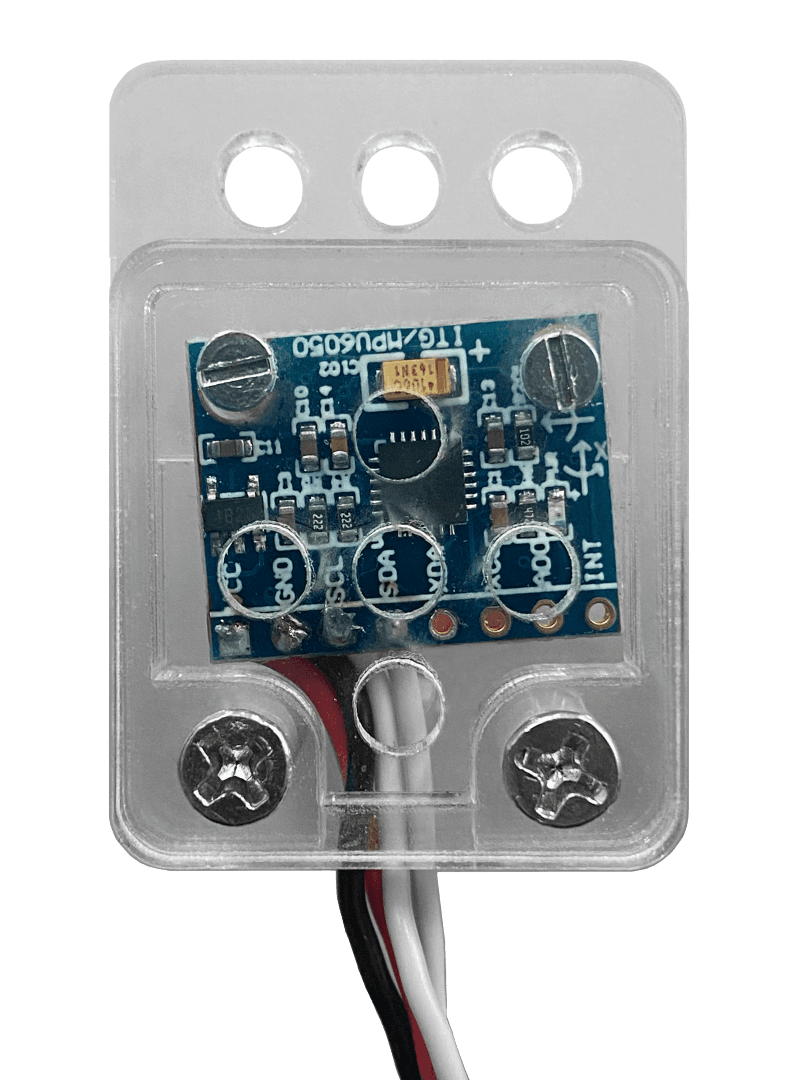
- gyroscope/accelerometer — 1;
- DC motor — 1;
- servo motor — 1;
- infrared sensors — 2;
- soil moisture sensor — 1;
- weather sensor — 1;
- 400-point breadboard — 1;
- SS8050 transistors — 4;
- 40-pin, 20 cm male-to-male wires — 1 set;
- 40-pin, 20 cm female-to-male wires — 1 set;
- digital multimeter — 1;
- power adapter cables — 2;
- MRT5 USB cable — 1;
- AA-57×17 battery holders — 2;
- cables with alligator clips — 3;
- plastic structural components: Pin 24 — 10, 70 mm plastic shaft — 2, Gear 30 — 1, Beam 15 — 4;
- 5RWWC white LEDs, 14,000 mcd, 6500 K, 3.4 V, 15° — 3.
The kit includes a digital teaching and learning package at no additional cost after a network cooperation agreement is concluded. Teacher training is provided online, along with technical support.
Skills and competencies
Students learn the fundamentals of electronics and circuit design, including how resistors, capacitors, LEDs, transistors, sensors, and other components work. They learn to write code to control devices; the built-in interpreter simplifies debugging. They assemble circuits without soldering using the assembly board's safe terminal connections.
Students develop skills in connecting and programming infrared, soil moisture, weather, and ultrasonic sensors, as well as motors and servos. They design interactive systems such as weather stations, alarms, and robots using an OLED display, buttons, and potentiometers. They also study automation and IoT fundamentals, including controlling devices based on conditions such as switching on a light according to the ambient light level. The kit can be used in agricultural technology classes.
Software included
Robotrack IDE is based on Arduino IDE and adds visual block programming, allowing users to create programs for the Trackduino controller without writing or editing code manually. It also supports Arduino C. Robotrack IDE information (in Russian). Robotrack IDE is supported on Windows and Linux Astra/Alt.
Documents
Related products