Robotics kits · Preschool education · Primary school · Middle and high school · Vocational and higher education · Robotics · Programming · Ministry of Industry and Trade register
The Robotrack Trackduino Project Kit is designed for project work. It is an important component for making an assembled robot model interactive when integrated with Robotrack robotics kits or resource kits. It includes everything needed for a range of student projects and is compatible with the plastic blocks in Robotrack robotics construction kits.
- Age
5 years and up
Description and specifications
Registry entry of the Ministry of Industry and Trade of the Russian Federation: No. 10587211.
Age: 5 years and up. Complies with Order No. 838 of the Russian Ministry of Education dated 28 November 2024 (clause 2.20.167) (in Russian). More on the Wiki (in Russian).
Trackduino is a multifunctional controller based on the Atmega2560 microcontroller. It is equipped for a wide range of robotics projects, with motor drivers for up to four DC motors, built-in Bluetooth, a power system that supplies voltage to all external ports, and an Arduino Uno interface for Arduino-compatible expansion boards. The controller is fully compatible with Arduino libraries and examples, so it can connect to actuators and sensors compatible with Arduino-family controllers.
Trackduino can be programmed in Robotrack IDE and Trekikod. Robotrack IDE is based on Arduino IDE and adds visual block programming, so programs can be created without manually writing or editing code; Arduino C is also supported. Trekikod can control both robotic devices using the Trackduino controller and virtual sprites, with block-based algorithms and artificial intelligence features. Robotrack IDE and Trekikod are supported on Windows and Linux Astra/Alt.
Expand the kit and explore additional technologies
- The kit can be integrated with neural networks (artificial intelligence) to control robots. Users can work with ready-made networks in Trekikod, NNTrack, and the Artintrek module, or integrate their own networks developed in NNTrack (in Russian).
- The Trackduino controller can be integrated with Robotrack robotics construction kits and resource kits for robotics, electrical engineering, neurotechnology, and other fields.
- The Energytrek Mini v2 resource kit can power the controller, avoiding the use of non-rechargeable batteries.
- The controller can be integrated with a Wi-Fi module to connect it to the internet. A dedicated web application supports IoT projects: it can receive sensor data and send commands to control actuators such as motors, servomotors, LEDs, and buzzers. The web application can be accessed from computers and mobile devices.
Kit contents
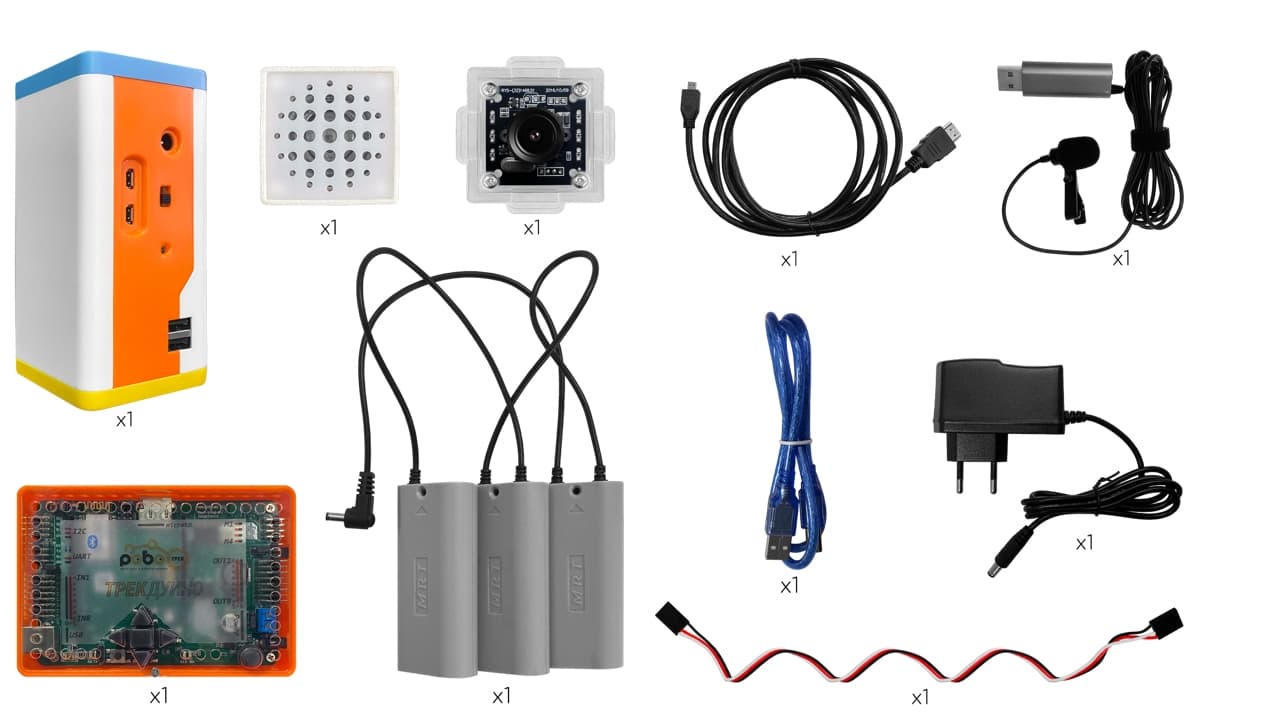
At least 3 components:
- Trackduino controller;
- USB cable;
- 9 V battery holder.
Trackduino controller specifications
- CPU: Atmega2560 with 256 KB of flash memory;
- 8 powered input ports (GND–Vin–S), all with ADC; ports 1–4 support interrupts; selectable 5 V or 3 V supply voltage;
- 8 powered output ports; ports 1–5 support hardware PWM; selectable 5 V or 3 V supply voltage;
- 4 DC motor ports driven by two L293 drivers with overcurrent protection;
- standard Arduino UNO R3 interface, independent of the other I/O ports, for Arduino shields and libraries;
- built-in Bluetooth for data transmission and microcontroller programming;
- microSD card slot;
- RGB LED;
- 5 programmable buttons;
- 2 powered USART ports (RX, TX, 5 V, GND);
- 2 powered I2C ports (SCL, SDA, 5 V, GND);
- computer connection via USB or Bluetooth;
- 7–12 V power supply and two power connectors: a jack for the kit's battery packs and a screw terminal for other power sources.
Skills and competencies
Working with the Trackduino controller, students learn electronics and microcontroller programming fundamentals, how to connect sensors and read their data, control motors and other actuators, and develop and debug programs for automation. Integration with Robotrack robotics construction kits and resource kits enables work with the broader system. The activities build systems thinking, algorithm design, hardware and software integration, programming, and controller testing skills, providing a foundation for further study of robotics and automation technologies.
Documents
Related products